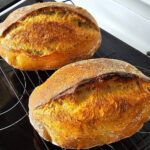
Sourdough Loaf
A super easy reliable sourdough test loaf
Servings 1 loaf
Ingredients
- 100 gm Sourdough Starter active and recently fed
- 300 gm Water 25-28c temp adjust qty slightly depending on flour
- 450 gm Bread Flour get the flour to room temp overnight
- 10 gm Salt
Optional
- 1 tbsp Olive Oil optional, softens the crust slightly.
Instructions
- Your starter should be active and vigorous. Feed it late evening of the day before you want to bake and leave in a warm place overnight. Feed again very early in the morning then let it double. It should double in size within 3 hours or so.
- I like to measure my flour and water and the evening before and leave it all in my prooving box to get up to temperature overnight. If your flour is cold it will affect the dough temperature and slow the prooving down.
- Autolyse your flour and water for an hour - Just mix the flour with the water, cover and leave in a warm spot for an hour.
- After an hour add your active starter and mix. Add the salt as your're mixing. Mix well by hand or use a stand mixer for 5-10 minutes with a dough hook for better results.
- Mix well, scrape down bowl and rest for 30 minutes.
- Stretch and Fold the dough, then rest for 30min. I do a coil fold at each stretch.
- Stretch and fold 3 more times. Then bulk proove for another 3-4 hours.
- Preshape the dough with a coil fold then rest uncovered another 15 minutes.
- Do a final coil fold trying to avoid degassing the dough then load into floured bannetons (I use rice flour to prevent sticking), with the seam side up (ie the top of your loaf is at the bottom of the banneton to pick up that nice rattan shape). At this point you can roll in seeds such as sesame poppy etc.
- Let rest for 20 minutes to relax then refrigerate overnight.
- 1 hour before baking get your oven preheating to 250c. It needs a full hour to heat the baking stones and dutch oven properly.
- Bake time, transfer out dough to parchment paper. I usually sprinkle a small amount of semolina onto the paper before turning out the dough. Score with a bakers lahm, then load into the screaming hot preheated dutch oven. Spritz well with water then quickly cover to trap the steam and return to oven.
- Bake for 20-30 minutes with lid on. Remove lid and bake another 10-15 minutes until desired level of scorch is reached.
- Remove from oven and allow to cool FULLY on a wire rack. Don't be tempted to slice into your newly baked loaf of bread till it's cool. It's still cooking while it's cooling down and your patience will be rewarded if you wait.
Notes
This recipe yields 860gm of dough at 66.6% hydration, enough for one decent size loaf.I usually double this recipe and bake two batards in my oval dutch oven. I prefer oval rather than the round boule shape as when sliced they fit better in my toaster.
You need an active starter for this dough. Buy one, find a baker friend and get given some, or make your own.
Bulk prooving begins when you add the starter to the flour. I usually bulk for about 5-6 hours total.
I usually feed my starter twice before baking. Once 2 days before mixing and then on the evening before the mix day to ensure it's at full robustness when introduced to the dough.
General rule of thumb with feeding a starter. Stir well, discard half and then add equal qty by weight of flour and water to maintain hydration at 100%. After feeding and baking you can store your remaining starter in the fridge to slow it down, but don't forget about it. It's alive remember and if you neglect it like any living thing it will die or become sick.
Dough temperatures are important. A good quality probe thermometer is invaluable for bread baking. I also have a homemade proofing box which keeps things around 25c degrees. It's made a huge difference to my baking results.
If you dont have bannetons you can use a normal metal loaf type tin lined with a well floured piece of fabric. Use Rice flour rather than wheat flour to dust the liner well in order to prevent the dough sticking to it.